Global supply chains have become increasingly complex. Companies must coordinate suppliers, manufacturers, warehouses, transportation providers, distributors, and customers across multiple countries and time zones.
At the same time, businesses operate in an environment characterized by fluctuating demand, transportation disruptions, labor shortages, rising operational costs, and increasingly demanding customer expectations.
Traditional supply chain management systems provide organizations with valuable visibility, but they often struggle to respond effectively to rapidly changing conditions.
Artificial Intelligence is transforming this landscape.
By combining machine learning, predictive analytics, computer vision, natural language processing, and intelligent automation, AI enables companies to anticipate demand, optimize transportation, improve inventory management, automate warehouse operations, and respond to disruptions faster.
The result is a shift from reactive supply chain management toward predictive and intelligent operations.
Instead of asking what happened yesterday, organizations can use AI to understand what is likely to happen next—and determine the best course of action.
Why Supply Chains Need Artificial Intelligence
Modern supply chains generate enormous amounts of data.
Information comes from:
- enterprise resource planning systems
- warehouse management platforms
- transportation management systems
- GPS and telematics devices
- IoT sensors
- e-commerce platforms
- customer orders
- supplier networks
- external market data
The challenge is not a lack of information. The challenge is turning this information into actionable decisions quickly enough.
Traditional systems typically rely on predefined rules and historical reporting. These approaches work well for stable environments but become less effective when demand changes unexpectedly or external disruptions occur.
AI enables supply chain systems to continuously analyze data and identify patterns that would be difficult to detect manually.
This allows organizations to move from static planning toward dynamic decision-making.
AI-Powered Demand Forecasting
Demand forecasting is one of the most valuable applications of AI in supply chain management.
Companies must constantly balance two competing risks:
- holding too much inventory
- running out of products
Excess inventory increases storage costs and ties up working capital. Stockouts result in lost sales, customer dissatisfaction, and potential damage to brand reputation.
Machine learning models improve forecasting accuracy by analyzing multiple variables simultaneously.
These may include:
- historical sales
- seasonal patterns
- promotions
- pricing changes
- customer behavior
- economic indicators
- weather conditions
- market trends
AI models can continuously update forecasts as new data becomes available.
This allows companies to adjust inventory and procurement decisions dynamically rather than relying solely on static historical averages.
Intelligent Inventory Management
Inventory optimization is closely connected to demand forecasting.
AI-powered systems help organizations determine:
- how much inventory to maintain
- when to reorder products
- which warehouses should hold specific items
- how inventory should be distributed
Machine learning models can identify demand patterns and predict potential stock shortages before they occur.
For businesses operating multiple warehouses, AI can optimize inventory allocation across locations, reducing unnecessary transfers and improving delivery times.
The result is a more efficient balance between product availability and inventory carrying costs.
Route Optimization
Transportation represents one of the largest operational expenses for many supply chain organizations.
AI helps optimize delivery routes by considering multiple variables simultaneously.
These can include:
- traffic conditions
- weather
- delivery windows
- vehicle capacity
- fuel consumption
- driver availability
- road restrictions
Instead of relying on static routes, AI systems can dynamically adjust transportation plans based on real-time conditions.
For logistics companies, this can lead to:
- shorter delivery times
- lower fuel consumption
- improved fleet utilization
- reduced transportation costs
Dynamic route optimization is particularly valuable for last-mile delivery, where small improvements can have a significant financial impact at scale.
Warehouse Automation
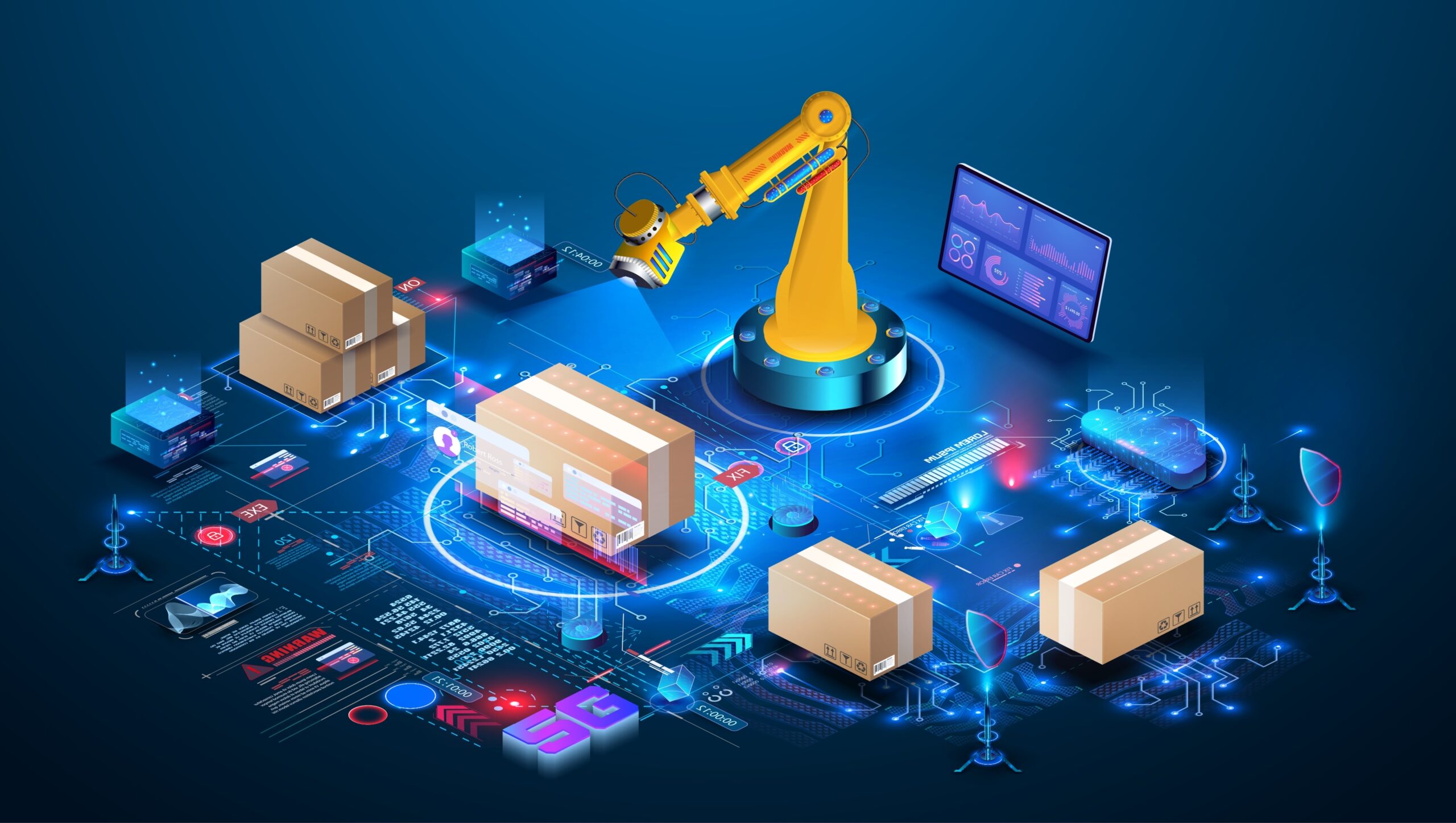
Warehouses are becoming increasingly intelligent through the combination of AI, robotics, computer vision, and IoT technologies.
AI-powered warehouse systems can optimize:
- product placement
- picking routes
- inventory movement
- workforce allocation
- order prioritization
Computer vision systems can automatically identify products, inspect packaging, and detect damaged goods.
Robotic systems can work alongside human employees to transport inventory and automate repetitive physical tasks.
AI coordinates these activities to improve warehouse productivity while reducing operational bottlenecks.
Predictive Maintenance
Unexpected equipment failures can cause significant disruptions across supply chains.
AI-powered predictive maintenance systems analyze data from:
- industrial machinery
- vehicles
- conveyor systems
- warehouse equipment
- IoT sensors
Machine learning models identify patterns that indicate potential equipment failures.
Instead of performing maintenance according to a fixed schedule, organizations can service equipment when the data indicates an increased probability of failure.
This approach reduces downtime, extends equipment lifespan, and lowers maintenance costs.
Supply Chain Risk Management
Global supply chains are vulnerable to unexpected disruptions.
Examples include:
- geopolitical events
- natural disasters
- supplier failures
- transportation delays
- labor shortages
- raw material price fluctuations
AI-powered risk management systems monitor internal and external data sources to identify emerging threats.
Predictive analytics can help organizations estimate the potential impact of disruptions and evaluate alternative scenarios.
For example, if a supplier is likely to experience delays, an AI system may recommend alternative suppliers or adjust inventory allocation before the disruption affects customers.
This enables companies to move from reactive crisis management toward proactive risk mitigation.
AI-Powered Procurement
Procurement teams manage complex relationships with suppliers and vendors.
AI can analyze supplier performance, pricing trends, delivery reliability, and market conditions to support better purchasing decisions.
Applications include:
- supplier risk assessment
- automated purchase recommendations
- price forecasting
- contract analysis
- supplier performance monitoring
Natural language processing can also analyze contracts and procurement documents, identifying important terms and potential risks.
This reduces administrative workloads while improving procurement decision-making.
Computer Vision in Logistics
Computer vision enables logistics organizations to automate visual inspection and monitoring processes.
Applications include:
- package recognition
- barcode scanning
- damage detection
- warehouse monitoring
- quality control
- automated sorting
For example, computer vision systems can inspect packages as they move through distribution centers and automatically identify damaged or incorrectly labeled shipments.
This improves accuracy while reducing manual inspection requirements.
AI in Last-Mile Delivery
The last mile is often the most expensive and complex part of the logistics process.
Customers increasingly expect:
- same-day delivery
- accurate delivery windows
- real-time tracking
- flexible delivery options
AI helps logistics companies optimize last-mile operations by predicting delivery times, optimizing routes, and dynamically assigning drivers.
AI-powered systems can also analyze customer preferences to determine the most convenient delivery options.
These capabilities improve customer satisfaction while reducing delivery costs.
AI in Supply Chain Visibility
A major challenge for global organizations is maintaining visibility across multiple tiers of suppliers.
Traditional systems often provide visibility only into direct suppliers, leaving organizations with limited insight into deeper parts of their supply chains.
AI can combine information from multiple sources to identify:
- supplier dependencies
- potential bottlenecks
- operational risks
- capacity constraints
This creates a more comprehensive view of supply chain performance.
Greater visibility allows organizations to respond faster when disruptions occur.
Generative AI in Logistics
Generative AI introduces new opportunities for supply chain professionals.
AI assistants can help employees:
- analyze logistics reports
- summarize supplier communications
- generate operational reports
- query supply chain data using natural language
- explain forecast changes
- identify potential risks
Instead of requiring specialized analytical skills, employees can interact with complex data through conversational interfaces.
This makes supply chain intelligence more accessible across the organization.
Benefits of AI in Logistics and Supply Chain
Organizations adopting AI can achieve improvements across multiple areas.
Lower Operational Costs
AI optimizes transportation, inventory, workforce allocation, and warehouse operations.
Better Forecast Accuracy
Machine learning improves demand predictions and reduces uncertainty.
Faster Decision-Making
AI processes large volumes of information faster than manual analysis.
Improved Customer Experience
More accurate delivery predictions and better product availability increase customer satisfaction.
Greater Resilience
Predictive risk management helps organizations respond to disruptions before they become critical.
Increased Sustainability
Optimized transportation routes and inventory management can reduce fuel consumption, waste, and unnecessary resource usage.
Challenges of AI Adoption
Despite its benefits, implementing AI in supply chains presents several challenges.
Data Fragmentation
Supply chain information is often distributed across multiple systems and organizations.
Integrating these data sources is essential for accurate AI models.
Legacy Infrastructure
Many logistics companies rely on older software platforms that were not designed for modern AI capabilities.
Integration and modernization strategies are therefore critical.
Data Quality
Poor-quality data can reduce model accuracy and lead to unreliable recommendations.
Organizations must invest in data governance and quality management.
Change Management
AI changes how employees make decisions and interact with technology.
Successful implementation requires training, communication, and organizational support.
Measuring the Business Impact
Organizations should measure AI initiatives against clear operational objectives.
Key metrics include:
- forecast accuracy
- inventory turnover
- order fulfillment time
- transportation costs
- warehouse productivity
- delivery accuracy
- equipment downtime
- stockout frequency
- customer satisfaction
These metrics help organizations identify the financial and operational impact of AI investments.
The Future of AI in Supply Chain Management
AI is moving supply chains toward increasingly autonomous operations.
Several developments will shape the future.
Autonomous Logistics
AI will increasingly coordinate transportation, inventory, and warehouse operations with minimal human intervention.
Digital Twins
Digital twins will allow organizations to create virtual models of supply chains and simulate potential disruptions before making operational decisions.
AI-Powered Control Towers
Intelligent control towers will provide real-time visibility across global supply networks and automatically recommend corrective actions.
Autonomous Warehouses
The combination of AI, robotics, computer vision, and IoT will create increasingly automated distribution centers.
Predictive Supply Chain Networks
Future supply chains will continuously anticipate demand, identify risks, and optimize operations in real time.
Artificial Intelligence is transforming logistics and supply chain management from a reactive operational function into a predictive and intelligent business capability.
By combining machine learning, predictive analytics, computer vision, IoT, and automation, organizations can improve forecasting, optimize transportation, reduce inventory costs, and respond more effectively to disruptions.
The most successful implementations will not treat AI as a standalone technology. Instead, they will integrate intelligent systems into the broader enterprise architecture, connecting data, people, and operational processes.
As global supply chains become increasingly complex, AI will play a central role in building more efficient, resilient, and sustainable logistics networks.