
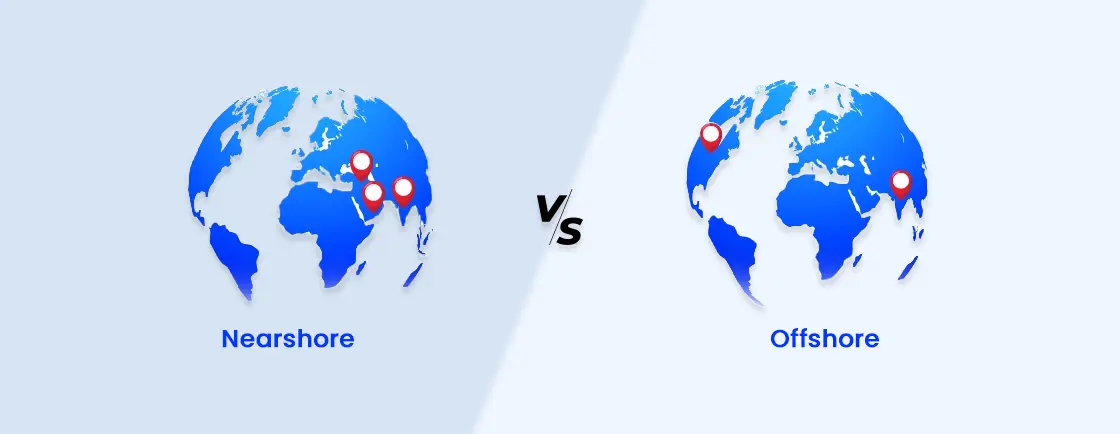
Choosing the right outsourcing model is one of the most critical decisions for CTOs and product leaders. While both offshore and nearshore development offer cost advantages, the real impact lies in how these models affect communication, iteration speed, and overall product delivery efficiency.
Offshore Development: Deep Dive
Offshore development involves working with teams in distant regions, often with significant time zone differences.
Advantages
- lower hourly rates
- large talent pools
- ability to scale quickly
Limitations
- delayed feedback cycles
- communication overhead
- cultural and process misalignment
Offshore works best for:
- well-defined tasks
- maintenance projects
- cost-driven initiatives
Nearshore Development: Deep Dive
Nearshore teams operate in similar or overlapping time zones.
Advantages
- real-time collaboration
- faster iterations
- stronger team integration
- higher product ownership
Trade-Off
- slightly higher cost compared to offshore
Productivity vs Cost Equation
While offshore appears cheaper on paper, hidden costs often arise:
- delays in communication
- rework due to misunderstandings
- longer development cycles
Nearshore teams typically deliver:
- faster releases
- better code quality
- improved collaboration
Hybrid Strategy
Modern companies often adopt a hybrid approach:
- nearshore core team
- offshore support for scaling
- in-house leadership
This balances cost efficiency and delivery speed.
Decision Framework
Choose offshore if:
- budget is the primary constraint
- tasks are repetitive or well-defined
Choose nearshore if:
- product requires frequent iteration
- real-time collaboration is critical
The decision is not purely financial — it is strategic. For most product-driven companies, nearshore or hybrid models provide better long-term outcomes.