
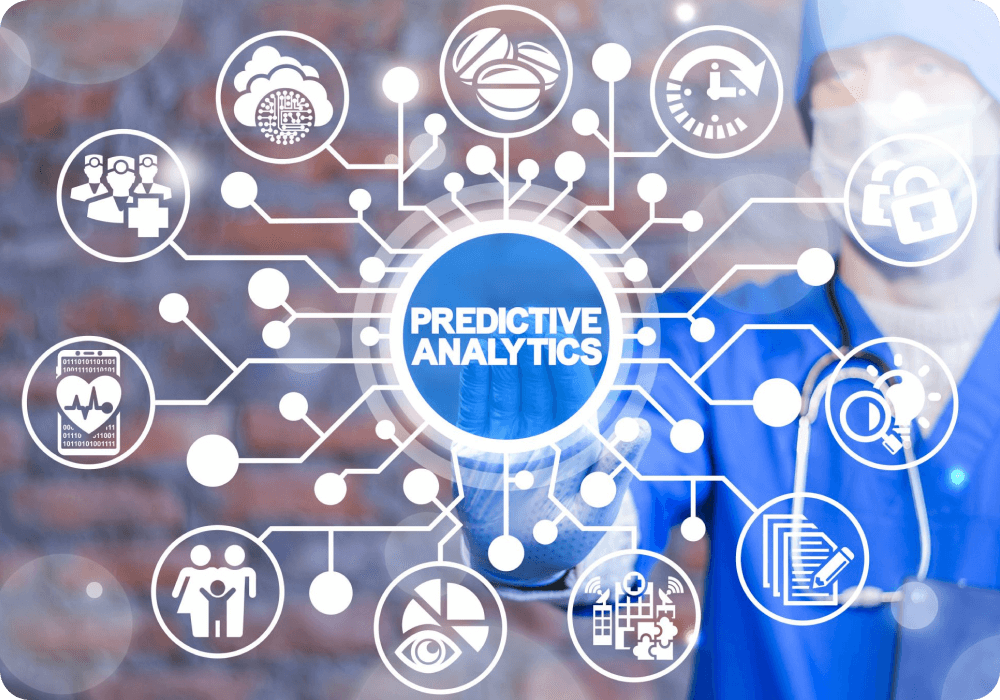
Predictive analytics powered by AI is revolutionizing healthcare by anticipating patient needs, optimizing treatments, and improving operational efficiency. By analyzing historical and real-time data, AI models forecast risks, enhance decision-making, and support preventive care. This article explores key applications, benefits, and strategies for implementing predictive analytics in healthcare.
What Is Predictive Analytics in Healthcare?
Predictive analytics in healthcare uses machine learning, statistical models, and AI algorithms to analyze patient data and predict future outcomes. Unlike traditional analytics, which focuses on understanding past events, predictive analytics anticipates potential health risks and trends, enabling proactive interventions.
Key capabilities:
Predicting disease progression and patient readmission
Identifying at-risk populations for preventive care
Optimizing hospital resource allocation
Supporting personalized treatment plans
Benefits of Predictive Analytics for Healthcare
Improved Patient Care: Early identification of health risks enables timely interventions.
Operational Efficiency: Optimizes staff allocation, bed management, and resource planning.
Cost Reduction: Prevents unnecessary treatments and hospitalizations.
Data-Driven Decision Making: Provides insights for clinical and administrative decisions.
Enhanced Research & Innovation: Identifies trends and patterns for drug development and treatment optimization.
Key Applications in Healthcare
Patient Risk Assessment
Predicts likelihood of disease, readmission, or complications.
Enables preventive measures and targeted care programs.
Hospital Management
Forecasts patient influx and resource demand.
Optimizes scheduling of staff, operating rooms, and equipment.
Personalized Medicine
Recommends tailored treatment plans based on patient history and genetic data.
Supports precision healthcare with AI-guided insights.
Clinical Decision Support
Assists doctors in diagnosis and treatment selection.
Analyzes large datasets to identify optimal interventions.
Population Health Management
Identifies health trends across communities.
Helps public health authorities plan preventive programs and policies.
Implementation Strategies for Healthcare Predictive Analytics
Data Collection & Integration: Aggregate electronic health records, lab results, and IoT data.
Model Development: Train AI and ML models to forecast patient outcomes.
Integration with Clinical Workflows: Embed predictive tools in hospital and clinic systems.
Monitoring & Validation: Continuously evaluate accuracy and refine models.
Compliance & Security: Ensure HIPAA and GDPR compliance to protect sensitive data.
At Richman Software Development, we provide custom AI predictive analytics solutions tailored to healthcare organizations, supporting proactive care, operational optimization, and better patient outcomes.
Richman Software Development Approach
AI Model Development: Design predictive models for patient risk assessment and operational forecasting.
Integration with Healthcare Systems: Connect analytics with EHRs, hospital management systems, and IoT devices.
Data Security & Compliance: Implement secure, compliant solutions that protect patient privacy.
Continuous Improvement: Monitor model performance and refine predictions for higher accuracy.
Predictive analytics is transforming healthcare by enabling proactive, data-driven decisions that improve patient outcomes and operational efficiency. Organizations that adopt AI-driven predictive solutions gain a competitive advantage in care quality, cost management, and strategic planning.
With Richman Software Development, healthcare providers can deploy scalable, secure, and intelligent predictive analytics solutions that drive measurable results.