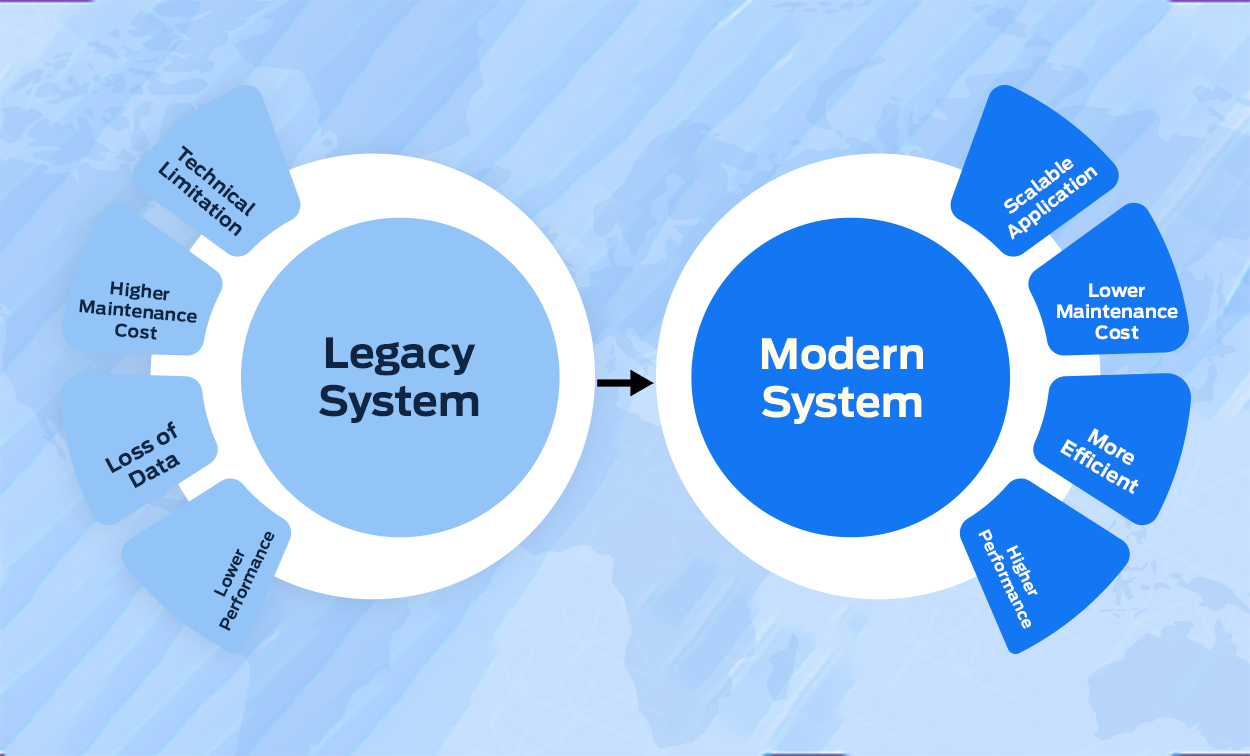
Many enterprises rely on legacy systems that were built 10–20 years ago using outdated technologies, monolithic architectures, and rigid infrastructure models.
While these systems often remain mission-critical, they increasingly become a bottleneck for innovation, scalability, and integration with modern platforms.
Legacy system modernization is the process of transforming these outdated systems into scalable, maintainable, and cloud-ready architectures without disrupting business continuity.
This process is not simply a technical upgrade — it is a strategic transformation of the entire digital foundation of a company.
What Is Legacy System Modernization?
Legacy modernization refers to the systematic process of updating or replacing outdated software systems to improve:
- performance
- scalability
- maintainability
- security
- integration capabilities
It often involves partial or full re-architecture of existing systems.
Why Legacy Systems Become a Problem
1. Technical Debt Accumulation
Over time, quick fixes and patches create a fragile codebase that is difficult to maintain.
2. Lack of Scalability
Older architectures are often monolithic, making horizontal scaling difficult or impossible.
3. Integration Limitations
Legacy systems struggle to integrate with modern APIs, cloud platforms, and third-party services.
4. Security Risks
Outdated frameworks and dependencies increase vulnerability to security breaches.
5. High Maintenance Costs
Maintaining legacy systems often requires specialized knowledge and expensive resources.
Modernization Strategies
There is no single approach to modernization. The strategy depends on system complexity, risk tolerance, and business goals.
1. Rehosting (Lift and Shift)
The simplest approach — moving existing systems to cloud infrastructure without major code changes.
Advantages:
- fast migration
- low initial cost
Limitations:
- no architectural improvements
- limited scalability benefits
2. Replatforming
Minor modifications are made to optimize the system for cloud environments.
Examples:
- database migration to managed services
- containerization of applications
This improves performance without full redesign.
3. Refactoring
The internal code structure is improved without changing external behavior.
Focus areas:
- code optimization
- removing technical debt
- improving maintainability
4. Re-architecting
The system is fully redesigned using modern architecture principles such as:
- microservices
- event-driven architecture
- API-first design
This is the most complex but also the most scalable approach.
5. Rebuilding
The system is completely rebuilt from scratch using modern technologies.
Used when:
- legacy system is too outdated
- maintenance cost exceeds replacement cost
Common Modern Architecture Patterns
Microservices Architecture
Breaks system into independent services that can scale individually.
Event-Driven Architecture
Uses asynchronous communication via events (Kafka, RabbitMQ).
Cloud-Native Architecture
Designed specifically for cloud environments using containers and orchestration tools.
Migration Challenges
1. Data Migration Complexity
Legacy databases often have inconsistent or undocumented structures.
2. System Downtime Risk
Migration must be carefully planned to avoid business disruption.
3. Integration with External Systems
Legacy systems often depend on tightly coupled external services.
4. Knowledge Gaps
Original system developers may no longer be available.
Migration Strategy Framework
A structured modernization process typically includes:
Phase 1: System Assessment
- architecture audit
- codebase analysis
- dependency mapping
Phase 2: Planning
- selecting modernization approach
- defining risk mitigation strategies
- creating migration roadmap
Phase 3: Incremental Migration
- breaking system into modules
- gradual replacement or migration
- parallel system operation
Phase 4: Validation
- performance testing
- data integrity checks
- security validation
Phase 5: Optimization
- scaling improvements
- monitoring setup
- continuous improvement
Business Benefits of Modernization
1. Improved Performance
Modern architectures significantly improve response times and system efficiency.
2. Scalability
Cloud-native systems allow horizontal scaling based on demand.
3. Reduced Operational Costs
Managed cloud services reduce infrastructure overhead.
4. Faster Innovation
Modern systems enable faster feature development and deployment.
5. Improved Security
Updated frameworks reduce vulnerability risks.
Role of Cloud in Modernization
Cloud platforms play a central role in modernization strategies:
- AWS provides scalable infrastructure services
- Azure integrates well with enterprise ecosystems
- GCP offers strong data and AI capabilities
Cloud adoption enables:
- elasticity
- automation
- global availability
Best Practices
- start with system audit before migration
- use incremental migration instead of “big bang” approach
- maintain backward compatibility during transition
- implement strong monitoring and observability
- involve both business and engineering stakeholders
Future of Legacy Modernization
Modernization is evolving toward:
- AI-assisted code refactoring
- automated migration tools
- self-optimizing cloud systems
- continuous modernization pipelines
Instead of one-time projects, modernization is becoming a continuous evolution process.
Legacy system modernization is essential for organizations that want to remain competitive in a rapidly evolving digital landscape.
By transitioning from outdated architectures to modern, cloud-native systems, companies can unlock scalability, reduce costs, and accelerate innovation.
Successful modernization is not just about replacing technology — it is about rebuilding the foundation for future growth.