
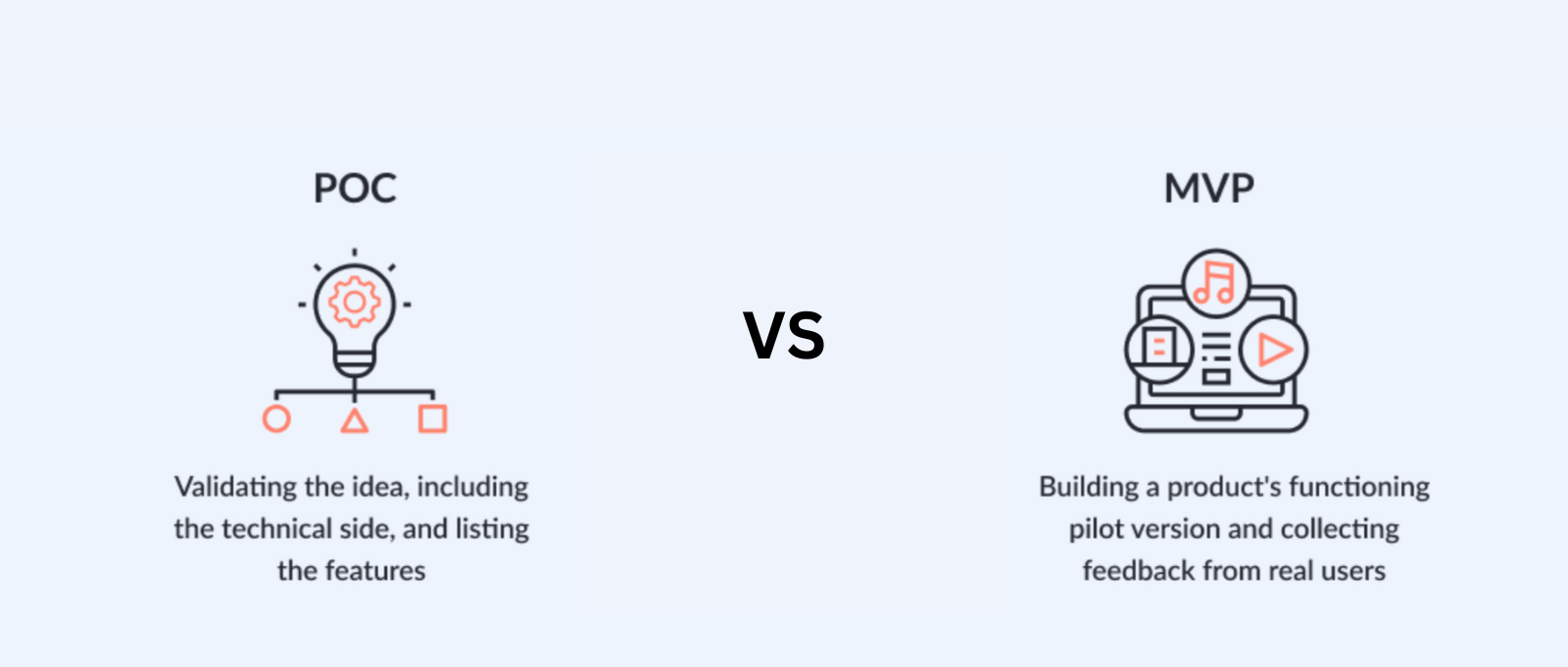
Startups and enterprises often confuse Proof of Concept (PoC) and Minimum Viable Product (MVP). Both are early-stage development approaches, but they serve different purposes. This article explains the distinctions, use cases, and how to choose the right approach for validating your product idea efficiently.
What Is a Proof of Concept (PoC)?
A Proof of Concept is a small-scale experiment designed to test technical feasibility or a core assumption of an idea. It answers the question: “Can this be built?” rather than “Will users adopt it?”
Key characteristics:
Focused on a single feature or functionality.
Short-term and low-cost development.
Validates technical risks or innovative approaches.
Not intended for public release.
Example: Testing if an AI algorithm can accurately predict user behavior before building a full product.
What Is a Minimum Viable Product (MVP)?
A Minimum Viable Product is a functional product with the minimum set of features required to solve a problem for real users. It answers the question: “Will users use this product?”
Key characteristics:
Functional and usable by the target audience.
Focused on delivering real value, not just technical proof.
Collects user feedback for further development.
Can be released publicly.
Example: A simplified version of a fintech app that allows users to track expenses and generate basic reports.
Proof of Concept (PoC) vs Minimum Viable Product (MVP): Key Differences
Purpose: A Proof of Concept (PoC) is designed to test technical feasibility, while a Minimum Viable Product (MVP) is aimed at validating product-market fit.
Scope: A PoC typically focuses on a single feature or concept, whereas an MVP includes the core functional product that delivers value to users.
Audience: PoCs are usually shared with the internal team or stakeholders, while MVPs are intended for real users or customers.
Time & Cost: PoCs are short-term and low cost, designed for quick validation, whereas MVPs require longer development time and moderate costs to ensure usability.
Outcome: A PoC determines if an idea can be built, while an MVP provides feedback for product evolution and guides future development decisions.
When to Use a PoC
Exploring new technologies (AI, blockchain, IoT)
Validating complex technical integrations
Testing proof-of-innovation concepts before major investment
Reducing development risk for enterprise projects
When to Use an MVP
Launching a startup product quickly
Testing market demand for a specific solution
Collecting user feedback to prioritize features
Iteratively developing a product with measurable KPIs
How PoC and MVP Complement Each Other
Many successful projects use PoC first, then MVP:
Build a PoC to confirm technical feasibility.
Once validated, develop an MVP to test market response.
Use MVP feedback to guide full-scale product development.
This approach reduces risk, saves costs, and accelerates time-to-market.
Richman Software Approach
At Richman Software Development, we provide:
PoC Development Packages: Rapid validation of innovative ideas.
100-Hour MVP Development: Quickly turn validated ideas into usable products.
Scalable Architecture Planning: Ensure MVPs evolve into enterprise-grade solutions.
Our clients benefit from a structured, risk-free approach that bridges technical feasibility and market success.
Understanding the difference between PoC and MVP is crucial for efficient product development. By strategically combining PoC and MVP, businesses can validate ideas, reduce risks, and build scalable, user-focused products.
With Richman Software Development, your innovation is tested, launched, and scaled with confidence.